
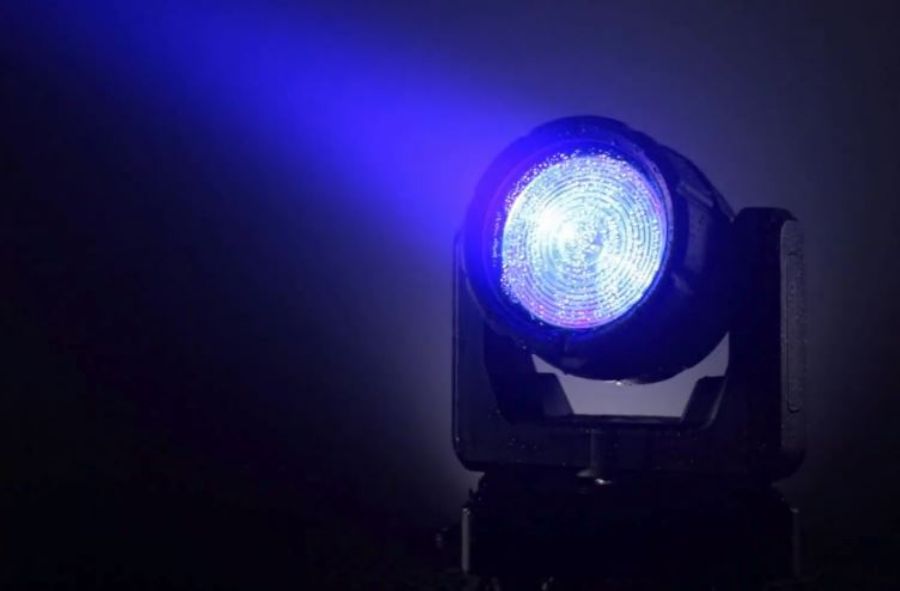
Deluge 120FX Moving Fresnel: IP65 Moving Head Wash with Aura Pixel Ring Explained
By the Edwards NZ Technical Team, New Zealand's AV specialists since 1974
The Deluge 120FX Moving Fresnel is a 120W RGBL IP65 moving head built by Event Lighting and supplied in New Zealand by Edwards Sound Systems, pairing a 140mm Fresnel wash engine with a 48 x 1W RGBWW pixel ring around the same lens housing. For DJs, rental companies, nightclubs, bars, schools, lighting techs, and theatre operators, that combination answers a specific scheduling problem: do you stock one fixture type that works both indoors and outdoors, or carry separate indoor-only washes and outdoor-rated units that sit idle depending on the venue. At 7kg and fully IP65-rated, the Deluge 120FX is built to go outside in rain, wind, or dust without the tent-and-prayer approach that indoor-only fixtures like a Martin MAC One or GLP impression FR1 require.
At a Glance
- Brand: Event Lighting (NZ supplied by Edwards Sound Systems)
- Model: DELUGEM120WFX
- Light engine: 120W RGBL, 140mm Fresnel lens
- Zoom range: 3.8° to 38°, motorised
- Output: 93,750 lux at 2m (3.8° zoom)
- Pixel ring: 48 x 1W RGBWW Aura LEDs
- Pan/tilt: 540° / 230°
- Dimming: 16-bit, flicker-free
- IP rating: IP65 (full outdoor use)
- Control: 5-pin DMX, ArtNet, sACN via RJ45
- Channel modes: 18 to 225
- LED lifespan: 50,000 hours
- Weight: 7kg
- Dimensions: 282 x 250 x 365mm
- Power: 100-240V AC, 180W max consumption
What does the dual light engine actually do?
The Deluge 120FX runs a single 120W RGBL wash through a 140mm Fresnel lens for soft-edged, even coverage, while a separate ring of 48 x 1W RGBWW LEDs surrounds that lens for pixel-mapped chase and aerial effects. For a rental company that currently stocks a plain wash fixture for ambient coverage and a separate pixel bar for chases, this reduces that to one head per position, which means less truck space, fewer cable runs, and one fewer fixture type to maintain spares for.
Why does the Lime LED channel matter?
The RGBL engine adds a Lime diode alongside Red, Green and Blue, filling the spectral gap that RGB-only fixtures leave in yellow-green wavelengths, which lifts both output brightness and the Colour Rendering Index of the white mix. For schools and theatre users projecting white-light washes onto sets, costumes, or performers, this means skin tones and fabric colours read more accurately on stage without needing a gel correction, and for video-capturing DJs and bars, white output looks less green or sickly on camera than a straight RGB mix.
What does the 3.8° to 38° motorised zoom give you?
The zoom range runs from a tight 3.8° beam at 93,750 lux at 2m out to a 38° flood, controlled remotely rather than by a manual barrel adjustment. A lighting tech programming a show can tighten the beam for a punchy aerial look during a drop, then flood the same fixture to a wide wash for a slow theatre cue, without re-rigging or swapping optics between songs or scenes.
Why does IP65 at 7kg matter more than it sounds?
IP65 means the housing is fully protected against dust ingress and low-pressure water jets from any direction, a rating most comparably powered fresnel washes only offer at a heavier weight class. At 7kg, two techs can mount, focus, and strike the Deluge 120FX on a truss or stand without rigging gear built for a heavier IP-rated fixture, which matters directly for school ball setups, vineyard weddings, and open-air bar fit-outs where load-in time is short and crew numbers are limited.
What does ArtNet and sACN support change for your rig?
Alongside standard 5-pin DMX, the Deluge 120FX accepts ArtNet and sACN over RJ45, letting it sit on a networked lighting rig instead of a traditional daisy-chained DMX line. For a rental company running a mixed rig across a marquee or festival site, this means one Cat5 run can carry multiple universes to multiple fixtures, cutting cable count and reducing the chance of a single broken DMX link taking out everything downstream of it.
Technical Depth: Key Specifications
What does 16-bit dimming actually change on stage?
16-bit dimming gives the Deluge 120FX 65,536 steps of intensity control compared with 256 steps on an 8-bit fixture, and that difference shows up specifically at the bottom of the dimming curve. An 8-bit fixture jumps in visible increments during a slow fade-to-black, which reads as flicker or banding on camera and as a visible "step" to an audience watching a theatre blackout cue; 16-bit control smooths that same fade so the transition looks continuous rather than staged in increments. For lighting techs running slow cues or DJs syncing intensity to a beat-matched fade, this is the difference between a clean cue and one that looks unfinished.
What do the 18 to 225 channel modes mean in practice?
The fixture's lower channel modes (18 and 23 channels) give you pan, tilt, colour, and zoom control without touching the Aura pixel ring individually, while higher channel counts up to 225 unlock full pixel-by-pixel control of the 48-LED ring for chases and pixel mapping. The gotcha here is real: patching the fixture in an 18-channel mode on your console will leave the Aura ring running as a single block rather than as individually addressable pixels, so if your show file calls for chase effects across the ring, you need to confirm the channel mode matches what your programming requires before patching night-of.
What does 93,750 lux at 2m actually tell you about throw distance?
That figure is measured at the tightest 3.8° zoom setting and at a fixed 2m distance, which is a lab condition, not a guaranteed result at your rig height. Lux falls off with the square of distance, so a fixture truss-mounted at 6m will read meaningfully lower than the spec sheet number; for outdoor work where ambient light is already a factor (daylight weddings, dusk functions), this means the Deluge 120FX's headline lux figure is a useful comparison point against other IP65 washes in the same class, not a literal promise of stage brightness at your specific rig height.
Setting Up the Deluge 120FX: First Patch Checklist
- Mount the fixture on an IP65-rated bracket or truss clamp and connect power using weatherproof connectors, confirming the 100-240V AC supply can handle 180W max draw per unit if running several off one circuit. Outdoor power runs are the most common point of failure on an otherwise correctly specified outdoor rig, so confirm circuit capacity before load-in day.
- Select the channel mode via the integrated LCD control panel, choosing between 18, 23, or a higher pixel-mapping mode up to 225 channels depending on whether you need simple wash control or full Aura ring addressing. Important: a low channel-count mode disables individual pixel control on the Aura ring, so confirm the mode matches your show file before you start programming.
- Set the DMX start address or network universe ID on the LCD panel, depending on whether you're running traditional 5-pin DMX daisy-chaining or ArtNet/sACN over RJ45.
- Choose your control protocol (DMX, ArtNet, or sACN) and terminate the line correctly if running standard DMX. Important: an unterminated DMX line or mixed protocols on the same daisy chain is a common cause of flicker or dropout on moving fixtures.
- If running standalone, set Auto, Sound-Active, or Master/Slave mode directly on the fixture, useful for a DJ or bar running the light without a dedicated console or operator on site.
- Load or build the fixture profile in your console software. As a recently released fixture, your console library may not yet carry a built-in Deluge 120FX personality, so check with Edwards or your console manufacturer before assuming a plug-and-play profile exists.
Is This a New or Updated Fixture?
The Deluge 120FX is a single-generation product from Event Lighting, with no prior MK1 model to compare against. Its DMX control chart is dated Version 1.1 (January 2026), which tells buyers this is a recently released fixture rather than one with years of field revisions behind it. The practical implication is that there's no long public track record of firmware updates or owner-reported fixes yet; buyers are relying on the IP65 spec and build quality rather than years of crowd-sourced reliability data, which is worth knowing going in rather than assuming otherwise.
How Does the Deluge 120FX Compare to the Fixtures Techs Actually Benchmark It Against?
Lighting techs discussing compact beam/wash options have named the Deluge 120FX directly alongside the Martin MAC One and GLP impression FR1, treating it as the value-positioned option in that category. Neither the MAC One nor the FR1 carries an IP rating for outdoor use, which is the core trade-off buyers are weighing.
Feature | Deluge 120FX (DELUGEM120WFX) | Martin MAC One | GLP impression FR1 | Elation Fuze Wash 500 |
Light engine | 120W RGBL + 48x1W RGBWW Aura ring | Single Fresnel LED engine | 60W RGBW single source | 500W RGBMA COB |
Zoom range | 3.8° to 38° | Approx. 4° to 27° | 3.5° to 35° | Wider range, higher output class |
IP rating | IP65 (full outdoor) | Not IP-rated | Not IP-rated | Outdoor-capable range available |
Weight | 7kg | 4.4kg | Lightweight/compact | Heavier, higher-power class |
Pixel/FX ring | Yes, 48-pixel Aura ring | Eye-candy effect, not full pixel ring | No, single source | Limited vs dual-engine design |
Control protocols | DMX, ArtNet, sACN, RJ45 | DMX | DMX, master/slave | DMX, network options |
The Deluge 120FX gives up some of the MAC One's lighter 4.4kg build and brand pedigree, but it's the only fixture in this table that can be rigged outdoors in rain without additional weatherproofing, and it's the only one carrying a pixel-mappable ring alongside the wash engine rather than a single light source. For a rental company stocking fixtures that need to cover both an indoor club install and an outdoor festival booking in the same month, that combination is the deciding factor, not raw output.
Pairing the Deluge 120FX with a networked DMX lighting controller gives you full access to its 18 to 225 channel modes, and rental companies building a dedicated outdoor fixture fleet often run it alongside the OUTBACK 12x40W IP65 Outdoor Moving Wash Light for broader area coverage, or the OUTBACK180B IP65 Outdoor Moving Head Beam for a sharper aerial complement to the Deluge's softer Fresnel wash.
Frequently Asked Questions
Is the Deluge 120FX a genuine budget alternative to the Martin MAC One or GLP FR1?
It's positioned that way by lighting techs comparing compact beam/wash fixtures, and the spec sheet supports the comparison on output and zoom range. The trade-off is that neither competitor carries an IP65 rating, so if outdoor deployment is part of your brief, the comparison favours the Deluge 120FX regardless of price, not just on cost.
Does ArtNet or sACN support actually matter, or is standard DMX enough for most rigs?
For a single fixture on a short run, standard 5-pin DMX is sufficient and the Deluge 120FX supports it natively. ArtNet and sACN over RJ45 matter once you're running multiple universes across a larger outdoor site or mixed rig, where network cabling reduces the number of physical DMX runs and the risk of one broken daisy chain taking out everything downstream.
Why do some moving heads move in visible steps instead of smoothly, and does this fixture avoid it?
Visible stepping during slow pan or tilt moves is typically an 8-bit DMX control issue, where coarse resolution makes movement look segmented rather than continuous. The Deluge 120FX runs 16-bit dimming for intensity control, which smooths fades at the bottom of the curve; pan and tilt smoothness during a slow cue will still depend on your console's output resolution and the channel mode selected, so confirm your programming uses the fixture's full control range.
Will my lighting console already have a profile for this fixture?
Not necessarily. The Deluge 120FX's DMX control chart is dated Version 1.1 (January 2026), which means it's a recently released fixture and some consoles may not yet carry a built-in personality for it. Check with Edwards or your console manufacturer before assuming a plug-and-play profile exists, and be prepared to build a custom personality using the 18 to 225 channel mode chart if needed.
If you're weighing up the Deluge 120FX against other IP65 or indoor moving heads for a specific venue, school event, or rental fleet, we can talk through channel modes, networking setup, and which fixture pairs best with what you're already running. Contact Edwards today

