
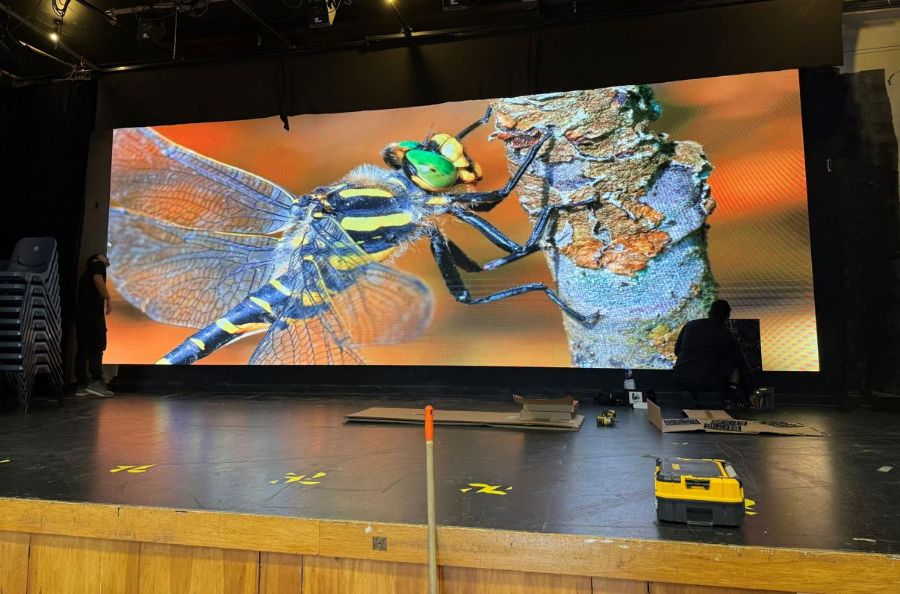
Every school hall carries the same risk: an important assembly, a full house of parents at prize-giving, or the opening night of the school production, and the visual is the one thing that has to work. A tired projector with fading lamp hours and a washed-out image in a hall full of ambient light isn't just an inconvenience, it's the moment a principal is standing in front of 400 people hoping the screen holds up.
That was the starting point for a leading Auckland independent school, who came to Edwards Sound Systems needing more than a brighter picture. They needed a permanent visual solution that would work every time, for every use the hall gets, without anyone on staff needing to think about it.
Edwards installed an 8-metre wide Lampro LED screen, originally specified as a backdrop for school productions. In practice, it now handles everything the hall is used for: assemblies, presentations, movie nights, and live events, with an image quality no projector in that space could match, and nothing for staff to maintain, calibrate, or replace.
It's a project that reflects a wider shift happening across Auckland schools right now. Permanent LED screen installation, once the domain of stadiums and concert venues, has reached a price and quality point in 2026 where it makes clear sense for any hall that works this hard, and any school ready to stop crossing its fingers every time the lights go down.
LED Screen at a Glance
- Screen width: 8 metres x 3 metres high (custom manufactured to specification)
- Manufacturer: Lampro
- Pixel pitch: P2.6–P3.9 (indoor, viewing distance dependent)
- GOB protection layer: LED pixels encapsulated against impact and contact damage
- Front-access maintenance: panels service from the front without structural access
- Installation time: approximately 2 days on-site
- Lead time: approximately 6 weeks from order
- Mounting: flat wall or custom frame (usually) no structural building work required
- Service area: Auckland and wider Auckland region
Why LED Screens Are Replacing Projectors in Schools and Churches
A projector works well in a darkened room with a clean screen and a lamp that has not accumulated thousands of hours. In a school hall or church, none of those conditions are reliable. Lamp hours accumulate, images fade, ambient light from windows washes out contrast, and the projection screen collects dust. The result is a dim, soft image that the back row cannot read clearly.
An LED screen has no lamp to replace and no contrast battle with ambient light. At P2.6–P3.9 pixel pitch, the image is sharp and bright at the viewing distances typical of a school hall or church are legible from the back row whether the sun is coming through the windows or not. For churches, large text and song lyrics are clearly readable across the full width of the congregation. For schools, presentation slides, video content, and live camera feeds hold their quality at full size.
The 2026 generation of Lampro LED panels represents a meaningful step up from earlier iterations, including tighter pixel pitch tolerances, improved colour uniformity across the panel array, and better thermal management for long-duration use.
GOB Protection: Why This Matters for Schools and Active Venues
Glue-on-Board (GOB) protection is a resin encapsulation layer applied directly over the LED pixels. It creates a hard, smooth surface across the panel face that absorbs contact and impact without transferring force to the individual LEDs underneath. In a school or church environment, where a chair leans against the stage, a broom is left resting on the screen, or a stray object makes contact during a production changeover, the GOB layer means the pixels themselves are protected.
Contact with the screen surface is still discouraged and may leave surface marks, but the LEDs and individual pixels will not be damaged. For venues where a basketball, a mic stand, or a piece of staging equipment occasionally makes contact with the screen, this is the difference between a cosmetic issue and an expensive repair.
Front-Access Maintenance: What It Means in Practice
Lampro LED screens installed by Edwards are designed for front-access servicing. If a panel or module ever requires replacement, it is accessed and swapped from the front face of the screen — no dismantling of the mounting frame, no access required from behind the wall, no structural work. A technician can swap a faulty panel on-site in a short visit.
This is a critical consideration for permanent installations in schools and churches where the screen is mounted against a solid wall or integrated into a stage structure. Front-access design means the long-term maintenance cost and disruption is kept to a minimum, and the screen continues operating with minimal downtime.
How Does a Permanent LED Screen Installation Work?
The process Edwards uses across Auckland is straightforward. One of Edwards’ technical sales team visits the site to assess the wall, viewing distance, ambient light, and power requirements. A large, flat wall is the ideal surface so no structural modification is needed, just the mounting frame and panels. The site visit establishes the right pixel pitch for your specific space and viewing depth before anything is ordered.
The screen is then manufactured to your exact dimensions. This matters: a custom-manufactured screen means every LED panel in the array comes from the same production batch, with matched colour temperature and brightness. Panels sourced from mixed warehouse stock can show colour and brightness variation across the screen surface that calibration cannot fully correct. From order to delivery is approximately six weeks.
On-site installation and commissioning takes around two days. Edwards handles every stage in-house across the Auckland region: the licensed electrician for power, the carpenters for mounting and framing, the programmers for calibration and control setup, and the technicians for commissioning. One team arrives, one team leaves, and the screen works.
LED Screen vs Projector: A Direct Comparison
| Projector | Lampro LED Screen |
Ambient light performance | Poor: washed out in daylight | Strong: readable in full ambient light |
Lamp / maintenance | Replacement every 2,000–4,000 hours | No lamp: LED lifespan 100,000+ hours |
Image sharpness | Softens with lamp age and distance | Consistent at P2.6–P3.9 across full hall depth |
Impact protection | Screen surface can tear or dent | GOB layer protects individual LEDs |
Servicing | Projector access required (ceiling or wall) | Front-access panel swap, no structural work |
Custom sizing | Limited to available screen products | Manufactured to exact dimensions |
Colour consistency | Degrades with lamp age | Batch-matched panels, consistent across array |
Frequently Asked Questions
What pixel pitch is right for a school hall or church?
Pixel pitch determines the minimum comfortable viewing distance, for example, a P2.6 panel is sharp from around 2.5 metres, a P3.9 from around 4 metres. For most school halls and churches with seating depths of 10–20 metres, P2.6–P3.9 covers the full range comfortably. Edwards’ site visit establishes the right specification for your specific space before anything is ordered.
Does the wall need to be modified or reinforced?
In most cases, no. A flat, solid wall is sufficient as a mounting surface and the LED panels attach to a frame that distributes the load. Edwards’ team assesses the wall during the site visit and will advise if any preparation is needed before installation day. No building consent or structural modification is typically required for a standard flat-wall installation.
Why does custom manufacturing matter versus off-the-shelf panels?
LED panels are manufactured in production batches, and colour temperature and brightness tolerances vary between batches. A custom-manufactured screen ensures every panel in your array comes from the same batch and the result is a visually consistent surface across the full width. Panels sourced from mixed warehouse stock can show colour and brightness variation that is visible in use and difficult to fully calibrate out.
How is the screen controlled and does it need a dedicated operator?
Edwards programmes the control processor during commissioning to suit how your venue actually operates. For a school hall, that typically means a simple interface a teacher or AV coordinator can run without technical training connecting a laptop or presenter device and switching inputs. The programming is done on-site before handover, not left for you to configure. you get a plug-and-play turnkey system.
Thinking About a Permanent LED Screen for Your Venue?
Edwards covers the full project across Auckland and the wider Auckland region from site assessment, custom manufacture, installation, and commissioning with a single in-house team. If you have a hall, church, or venue with a flat wall and a use case that outgrew your projector, get in touch and we’ll come and have a look.
Contact Edwards today: https://www.edwardsnz.co.nz/integrasellpage/render?pageName=Contact-Information

