
The Audiocenter D4.2K-D is a 4-channel Class D power amplifier delivering 4×500W at 4Ω or 2×1000W bridged at 8Ω, with built-in DSP processing, Dante audio networking, and AES/EBU digital inputs all in a 2U rackmount chassis weighing 8.5kg. It is the amplifier you specify when analogue power alone is not enough and you need network audio, precision signal processing, and remote system control in a single unit.
Edwards Sound Systems has stocked and sold Audiocenter amplifiers since 2010 and the new D4.2K-D is now among the strongest performers in the range.
At a Glance
- Model: Audiocenter D4.2K-D
- Output: 4×500W @ 4Ω stereo / 2×1000W @ 8Ω bridged / 4×300W @ 8Ω stereo
- Amplifier class: Class D, >90% power efficiency
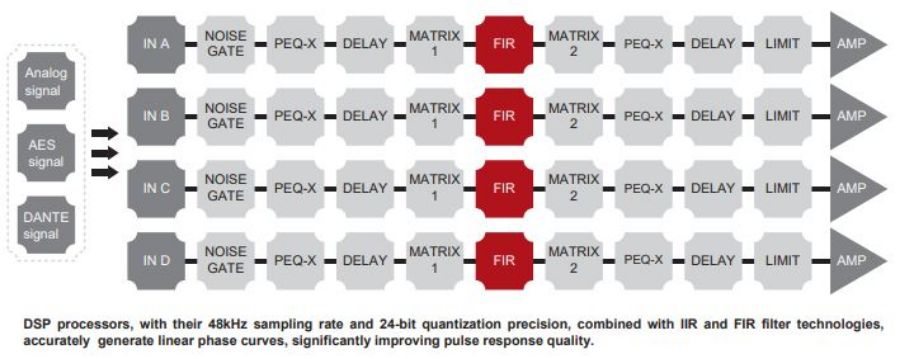
- DSP: Built-in BrainCore™, 48kHz/24-bit, IIR + FIR filters (4×2048 taps)
- Input EQ: 15-band parametric per channel + HPF/LPF (6–48dB/oct, Butterworth, Linkwitz-Riley, Bessel)
- Output EQ: 10-band parametric per channel + HPF/LPF
- Input delay: 90ms per channel / Output delay: 20ms per channel
- Digital inputs: 4× Dante, 4× AES/EBU, 4× analogue XLR
- Output connectors: Speakon
- S/N ratio: ≥100dB (A-weighted)
- THD+N: ≤0.1% (1kHz, 8Ω half power)
- Damping factor: ≥400 @ 1kHz/8Ω
- Frequency response: 20Hz–20kHz ±1dB
- Network control: BrainCore NET, up to 250 devices, RJ45 ×2
- Rack space: 2U / Weight: 8.5kg
What Separates the D4.2K-D from a Standard 4-Channel Amplifier?
Most 4-channel amplifiers do one thing: amplify. The D4.2K-D adds three capabilities that would otherwise require separate rack units: a full-featured DSP processor, a Dante audio network interface, and a remote network control system. For an AV integrator or system designer specifying a permanent installation, that consolidation matters such as fewer rack units, fewer points of failure, and a single network port handling both audio transport and system control.
The built-in DSP is not a simplified crossover module. It includes 15-band parametric EQ per input channel, 10-band parametric EQ per output channel, HPF/LPF filters with adjustable slopes from 6 to 48dB per octave across three filter types, 90ms input delay per channel, 20ms output delay per channel, compressor and limiter per output, and FIR filtering at 4×2048 taps. This is the processing suite you would expect in a dedicated DSP unit and here it is built into the amplifier.
Why Does Dante Matter in an Amplifier?
Dante is the most widely deployed networked audio protocol in professional AV installations. It carries multiple channels of uncompressed digital audio over standard Ethernet infrastructure; the same cabling and switches used for data networking. In a building with existing Cat5e or Cat6 cabling, Dante audio can run alongside data traffic on the same network with no specialist cabling required.
The D4.2K-D implements full Dante with a channel capacity of up to 512×512. More practically for most installations: the Dante-enabled version integrates both audio transport and BrainCore NET software control through a single RJ45 port. One cable carries audio from the network and returns control data. For a system integrator running structured cabling through a building, that is a meaningful reduction in rack wiring and installation time.
The amplifier also accepts AES/EBU digital input and analogue XLR simultaneously, with configurable matrix routing between inputs and output channels. A system can receive audio from a Dante network, an AES/EBU digital source, or analogue and route any input to any output channel in software.
Who Is the D4.2K-D Right For?
Theatres and performing arts venues requiring precise delay alignment between speaker zones, tuned crossover points, and the ability to recall preset configurations for different production types. The FIR filter implementation and per-channel delay give a theatre system designer the tools to time-align a complex multi-zone system without a separate processor.
Churches and houses of worship with distributed audio across main PA, stage monitors, overflow areas, and hearing loop feeds. Dante integration means the amplifier connects directly to a Dante-enabled mixing console or audio network without analogue cable runs back to the amp rack.
Corporate AV installations where multiple rooms share a Dante audio network and amplifiers need to be managed remotely. BrainCore NET can monitor and control up to 250 devices from a single software interface useful for facilities management teams responsible for multiple rooms or buildings.
Touring systems where 8.5kg of 4-channel amplification with onboard DSP replaces a heavier amplifier and a separate processor, reducing the weight and rack space of the system drive rack.
What Does 15 Years of Audiocenter Performance Look Like in Practice?
Edwards Sound Systems has supplied and installed Audiocenter amplifiers since 2010. In that time the brand has built a track record in NZ installations for reliability under continuous use the kind of performance that matters in a venue running the same amplifier rack through multiple shows per week for years without intervention. The D series represents the current top of the Audiocenter amplifier range, and the D4.2K-D is the entry point into that series: the same DSP architecture and Dante implementation as the larger D4.6K-D (4×1500W), at a price point that suits mid-scale permanent installations.
The D4.2K-D is priced competitively for what it includes. A comparable specification 4-channel Class D amplifier, separate DSP processor with equivalent filter depth, and a Dante interface all assembled from separate units would cost considerably more and occupy additional rack space.
How Does the D4.2K-D Compare to a Separate Amplifier and DSP Processor?
| Separate amplifier + DSP + Dante interface | Audiocenter D4.2K-D | |
|---|---|---|
| Rack units | 4U–6U minimum | 2U |
| Weight | 15–25kg typical | 8.5kg |
| Cabling | Analogue between DSP and amp | Internal - no inter-unit cabling |
| Network control | Multiple software platforms | Single BrainCore NET instance |
| Points of failure | 3 units, multiple connections | 1 unit |
| Approximate cost (NZD) | $4,000–$7,000+ | $1,949 incl. GST |
Frequently Asked Questions
Can the D4.2K-D run on a standard NZ power outlet?
Yes. The D4.2K-D supports 220–240V~ (±10%, 50/60Hz) and draws 375W at one-eighth output power into 4Ω well within a standard 10A circuit. At full rated output the draw increases, but for most installation scenarios a dedicated 15A or 20A circuit is recommended for headroom.
Does the DSP require separate software to configure, or can it be set up from the front panel?
Both options are available. Basic configuration — gain, sensitivity, mute — can be done from the front panel display. Full DSP configuration including EQ curves, filter settings, delay values, and routing is done via BrainCore NET software over USB or Ethernet. For complex installations, the software gives a visual interface for all processing parameters across all channels simultaneously.
What is the difference between the D4.2K-D and the D4.6K-D?
The D4.6K-D delivers 4×1500W at 4Ω and 2×3000W bridged at 8Ω. The DSP architecture, Dante implementation, and BrainCore NET integration are identical across both models. The choice between them comes down to the speaker load and SPL requirements of the installation, the D4.2K-D suits mid-scale systems; the D4.6K-D is specified for larger venues or high-output speaker systems.
Is the D4.2K-D compatible with third-party Dante devices from other manufacturers?
Yes. Dante is an open, licensed protocol managed by Audinate. The D4.2K-D will interoperate with any Dante-enabled device mixing consoles, DSP processors, audio interfaces, and amplifiers from any manufacturer using standard Dante Controller software for routing configuration.
The Audiocenter D4.2K-D is available from Edwards Sound Systems (currently) at $1,949 incl. GST. If you're specifying a system where Dante networking, onboard DSP, and 4-channel amplification need to coexist in a compact, reliable package, it is worth a conversation.
View the D4.2K-D on the Edwards website or contact Edwards today to discuss whether it's the right fit for your installation.

