
There is a moment at the end of every prize-giving, every concert finale, every championship announcement, when someone in the room thinks: we need something bigger than this. A spotlight feels thin. Confetti feels tired. A standard fog machine pushes out a cloud that drifts sideways and settles on the front row.
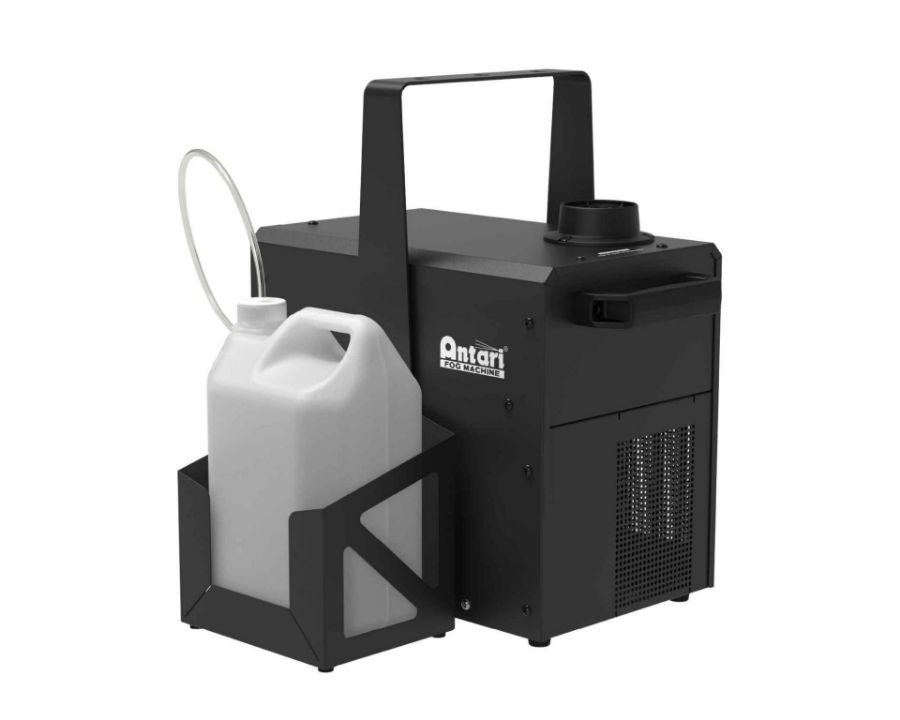
The Antari J-100 Sonic Jet fires 2700 watts of fog directly into the sky.
Not a cloud. A jet! A high-pressure turbo-fan column of fog that launches upward and outward with the kind of force that makes an audience flinch and then cheer. It is the difference between atmosphere and impact and once you have seen it fire, a standard fogger looks like a kettle.
Edwards Sound Systems now stocks the J-100 in Auckland. This is not a machine for every event. It is a machine for the people who have run every event and know that the moments that get remembered are the ones that felt like they meant something.
What Does a Fog Jet Actually Do?
A standard fog machine heats glycol-water fluid to produce vapour, which drifts out of a nozzle and spreads across the stage. It creates atmosphere. It is useful, reliable, and present at roughly every live event in the country.
The J-100 does something categorically different. A high-pressure turbo fan forces fog through a directional nozzle at high velocity, producing a concentrated, fast-moving burst that travels upward, outward, with force. At 250ml/min fluid consumption and 2700W of power, the output volume is substantial. The visual effect is not fog settling across a stage. It is fog being fired into the room.
Think of the difference between smoke from a fire and smoke from a flare. One fills the air. The other goes somewhere on purpose.
The Moments the J-100 Was Built For
The prize-giving reveal. The name is announced. The winner stands. The J-100 fires. Every school awards night, every sports prize-giving, every corporate gala dinner that has ever felt like it needed one more thing... this is that thing. The jet fires on DMX cue, responds instantly, and the effect reads clearly from the back of the largest hall.
The concert entrance. Side of stage, pointed upward, triggered the second the artist walks on. The J-100 is what you see at major international productions when the headliner appears through a wall of fog. It is now available to buy in Auckland for $3,999 incl. GST.
The outdoor festival moment. IP53-rated, which means it is protected against dust and water spray from any direction. Most fog machines carry no IP rating at all — they are strictly indoor equipment that fails in the open air. The J-100 is built for outdoor stages, open-sided marquees, and festival environments where the weather does what it likes and the machine has to work anyway.
The DJ drop. At the peak of the track, on the beat, the jet fires. No warm-up delay. Fast response, consistent output, DMX-triggered to the millisecond. The crowd feels it before they understand what happened.
The theatre reveal. A character appears through a column of fog. A door opens onto a wall of white. A transformation happens centre stage and the audience believes it because the physical effect is real, not projected.
Why IP53 Matters More Than You Think
IP ratings measure protection against ingress dust (first digit) and water (second digit). IP53 means the J-100 is protected against dust that would affect operation, and against water spray from any direction at up to 60 degrees from vertical.
For outdoor events, this is the specification that separates a machine you can deploy with confidence from one you are crossing your fingers about. Auckland weather does not announce itself. Marquees leak. Ocean-side venues have spray. Open-air concerts get rained on.
A standard fog machine at an outdoor event is a risk calculation. The J-100 is not.
What Does the J-100 Need to Run?
It runs on standard 220–240V single-phase power — a normal 15A circuit with adequate headroom. It uses Antari FLK fluid specifically — a fast-dissipating formula developed for jet fog machines that clears quickly after the effect, leaving the air clean rather than filling the space. FLK is not the same as standard FLG fog fluid. At 250ml/min consumption, a 4-litre bottle of FLK covers roughly 16 minutes of full-output operation, in practice, far longer, because the machine fires in bursts rather than continuous output.
Control is via front panel, timer, DMX512, wireless remote, or W-DMX. The wireless and W-DMX module is optional. For a touring production running lighting from a console, DMX is the obvious choice. For a one-off event where running cable is impractical, the wireless option handles it.
Weight is 18.7kg with an external fluid tank. It needs to be positioned and secured this is not a machine you leave unattended in a crowd, and not one you set up in five minutes without a plan. That is not a criticism. It is the nature of equipment that does something serious.
Is This Machine Right for You?
Honestly, probably not. Most events do not need a fog jet. A standard fog machine does the job well, costs less, uses cheaper fluid, and requires less setup thought.
The J-100 is for the event that cannot afford to be ordinary. The school that wants its prize-giving to feel like a stadium show. The touring production that needs outdoor fog on a festival stage regardless of weather. The corporate event company that has a client who has seen it all and needs to be surprised. The DJ who wants the drop to be physical, not just sonic.
If that is the brief, this is the machine.
The J-100 Antari Sonic Jet is in stock at Edwards Sound Systems, Auckland, at $3,999 incl. GST.
Antari FLK-4 fog fluid (4 litres) for the J-100 is available at $79.50 incl. GST.
The optional wireless/W-DMX control module is available separately — contact Edwards for pricing.

